
How TroutCast Works
Martin, J.T., Pederson, G.T., Cline, T., Lahr, A., Walker, J.D., Schmetterling, D., Bell, D., & Muhlfeld, C. (in press). An integrated drought early warning system for cold-water fisheries management. Fisheries. https://doi.org/10.1093/fshmag/vuag035
Montana state law allows for the implementation of fishing restrictions on Montana watercourses at the discretion of Montana Fish, Wildlife, and Parks (FWP) when pre-determined low flow and/or high stream temperatures occur provided that other relevant criteria are met (ARM 12.5.507, 2022). Criteria for temperature related restrictions include daily maximum water temperatures equal to or exceeding 73 °F at any time during the day for three consecutive days in non-native salmonid (NNS) streams with equivalent temperature thresholds of 66 °F and 60 °F in cutthroat trout (CT) and bull trout (BT) streams respectively. Criteria for flow related restrictions include streamflow below the 5th percentile of daily mean values based upon hydrologic records for that water body except for water bodies with alternative low-flow thresholds stated in a specific drought management plan for that location. However, not all days identified as restriction days may align with actual restrictions because the decision to implement real time fishing restrictions ultimately rests with regional Montana FWP biologists and depends on additional factors beyond stream conditions. As such, assessments of fishing restrictions and closures presented here should be viewed as estimates of restrictions and closures likelihood based on regulations and data as they stand at the time of publication.
The model developed here is run daily between May 1st and October 31st. This timeframe maximizes the period over which U.S. Geological Survey (USGS) streamgages are generally ice-free and reporting data and typically covers the warm season period over which drought conditions stressful to salmonids occur. The model generates two primary statistics which are the probabilities of reaching the management threshold for either streamflow (P[flow]) or stream temperature (P[temp]) within a given forecast period, with 0 ≤ P ≤ 1. The probability of reaching either management threshold is also provided and calculated as P[flow or temp] = P[flow] + P[temp] - P[flow and temp]. The forecast period is flexible, but to maximize forecast information while maintaining simplicity, restriction probabilities are generated each day for 4 outlook periods of 1, 2, 3, and 4 weeks. Importantly, the probability generated for a given outlook period is the probability of meeting restriction criteria at any time prior to the end of that period, including prior weeks. For example, the restriction probability generated for week three on July 1st would be the probability of meeting restriction criteria on any day between July 2nd and July 22nd.
Cline, T. J., Lahr, A., Pederson, G. T., Martin, J., Schmetterling, D., Bell, D. A., & Muhlfeld, C. C. (2026). Streamflow drought limits fish production across river ecosystems. bioRxiv. https://doi.org/10.64898/2026.05.05.723077
TroutCast uses an age-based population model to forecast fish population trends across Montana’s blue-ribbon trout rivers. The model combines long-term fish survey data and streamflow data to estimate how fish populations are likely to change under current flow conditions.
- Fish density data
- Collected by Montana FWP through annual electrofishing surveys.
- Fish density is typically measured as number of fish per mile in each river section.
- Surveys provide population estimates for different age classes of trout.
- Streamflow data
- Collected by USGS streamgages, which measure streamflow continuously throughout the year.
- For the model, flow data are summarized seasonally (e.g., summer, winter) to reflect biologically important periods for fish growth and survival.
The TroutCast model links streamflow to two key population processes: reproduction and adult survival. These processes operate on different time lags, depending on the age of the fish and when flow occurred.
To model these processes, each year’s fish population is divided into two age classes:
- Recruits: Young fish captured for the first time, assumed to be 2 years old.
- Spawners: Sexually mature fish, assumed to be age 3 or older.
These age classifications are based on expert input from FWP biologists.
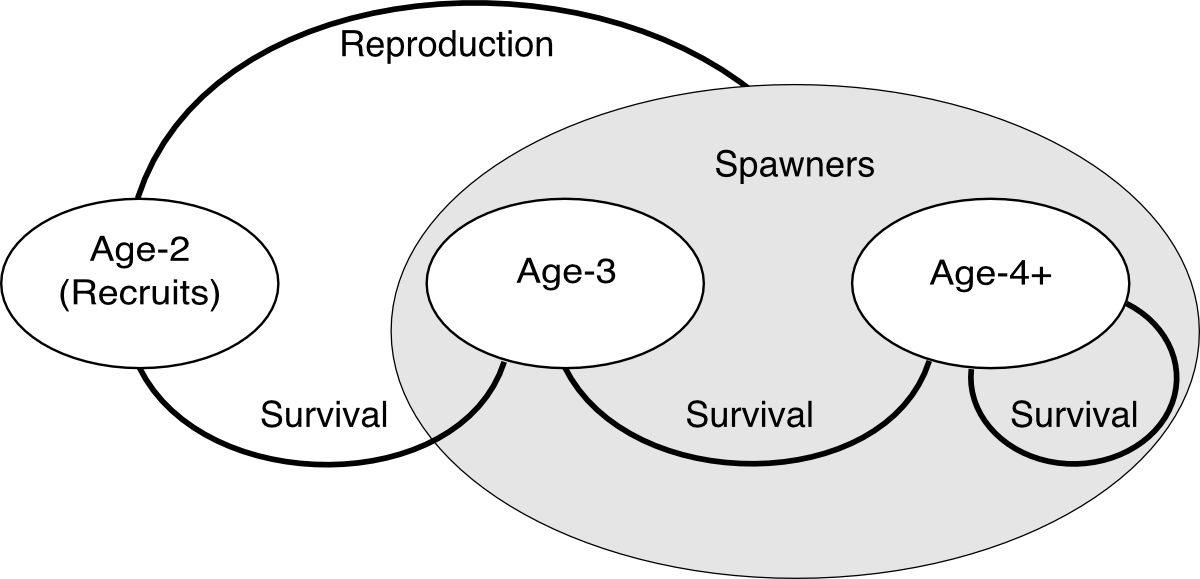
Streamflow affects fish at different life stages and across different time periods:
- Reproduction (1–3 year lag)
- Recruits are 2 years old, meaning they were affected by three consecutive years of flow conditions:
- The year they were spawned
- The year they hatched and grew as juveniles
- The year before they were captured
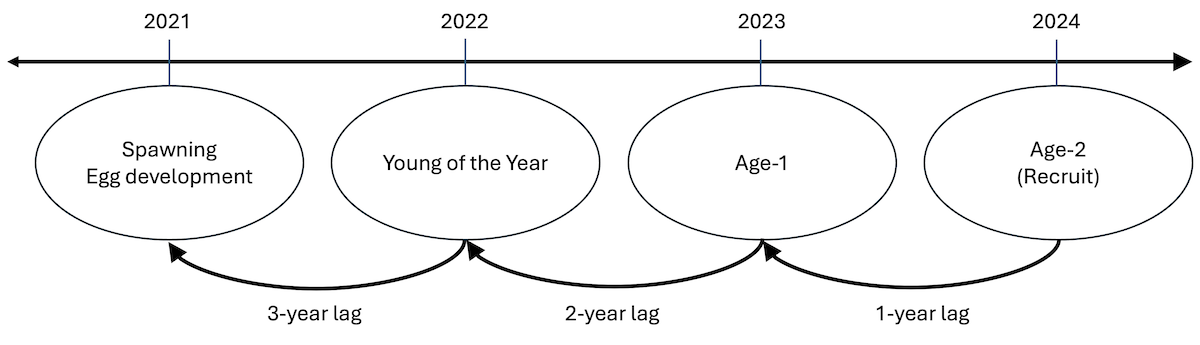
- Recruits are 2 years old, meaning they were affected by three consecutive years of flow conditions:
- Survival (1 year lag)
- Spawners (adult fish) are influenced by streamflow between the previous and current year’s surveys, which affects their survival to the next season.
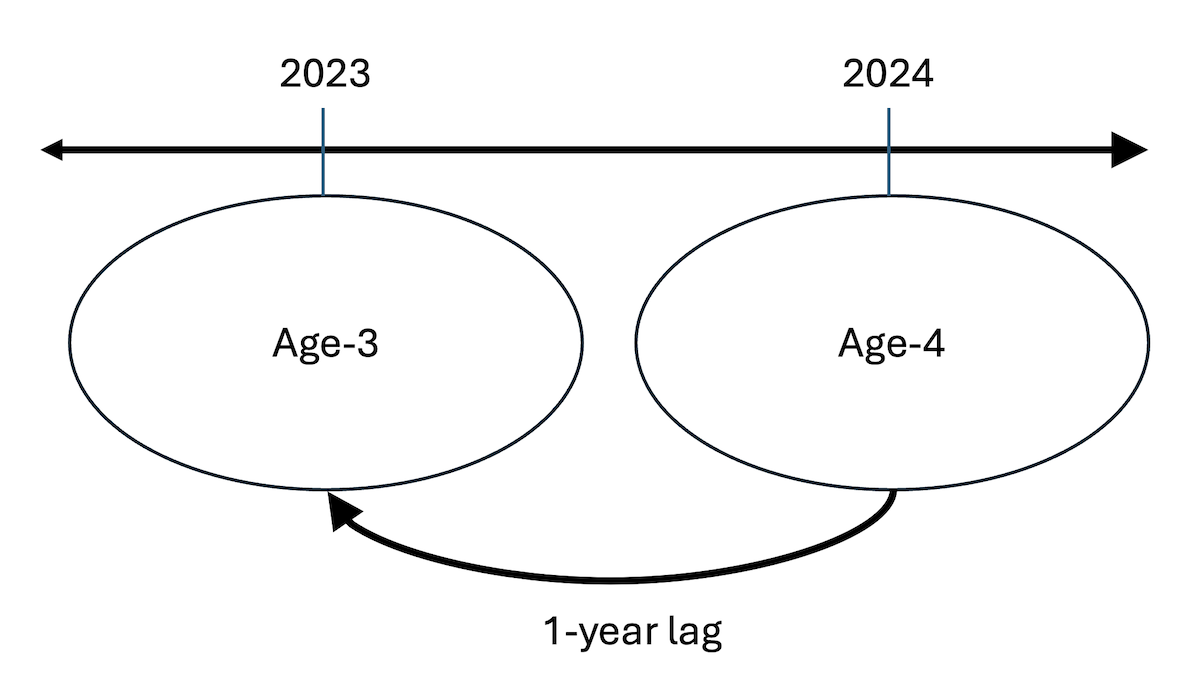
Using current streamflow conditions and the most recent fish population estimates, TroutCast projects future fish abundance. The model generates a range (distribution) of possible outcomes based on past patterns and flow conditions.
TroutCast summarizes population forecasts using three status categories:
- Increase: More than 50% of forecasted outcomes are higher than last year's estimate
- Stable: More than 50% of forecasted outcomes are within the range of last year's estimate
- Decrease: More than 50% of forecasted outcomes are lower than last year's estimate
These categories help resource managers and the public quickly assess whether populations are expected to improve, remain steady, or decline under current streamflow conditions.
Understanding how streamflow affects fish populations helps inform conservation, restoration, and fisheries and water management decisions—especially as drought and climate variability increase. By forecasting trends at the scale of individual rivers, TroutCast supports proactive management and helps protect the ecological health and recreational value of Montana's rivers.