



Best Student or Post-Doc led publication award
The Cooperative Research Units Program celebrates the 2026 Best Paper Award winners for producing rigorous, impactful science that supports conservation and agency decision‑making. These papers showcase strong partnerships and meaningful advances in fish and wildlife research.
Caroline Cappello
Caroline Cappello worked as a post-doc with Dr. Javan Bauder at the Arizona Cooperative Fish and Wildlife from 2022-2024. Funded by Arizona Game and Fish Department (AGFD), Caroline’s research covered a diversity of topics ranging from Bald eagle (Haliaeetus leucocephalus) nest parasites, to modeling habitat selection by subadult eagles to inform electrocution risk, to describing the migratory patterns of subadult eagles born in Arizona. The primary focus of her postdoc was her work on Bald eagle population dynamics in Arizona. Dr. Cappello has won CRU’s Best Student/Post-doc Paper for 2026 for her paper “Evaluating the effects of nest management on a recovering raptor using integrated population modeling” (citation below).
Paper Abstract and Citation:
Most bald eagles breeding within the American southwest breed in Arizona. Arizona’s breeding population of bald eagles appears demographically isolated from other breeding populations of bald eagles in North America and the number of bald eagle breeding pairs in Arizona has increased over the past few decades. Arizona Game and Fish Department (AGFD), together with many collaborating agencies, tribes, and utility companies, have monitored Arizona’s breeding population of bald eagles and use two nest-level management practices to promote bald eagle nest success: closures around nests and continuous monitoring of active nests by trained volunteers called nest watchers. The goal of this project was to combine multiple long-term data sets, including band-resight data, nest productivity data, and telemetry data from subadult bald eagles, into a single integrated modeling framework that could be used to predict future bald eagle population trends and evaluate how those trends are influenced by nest area closures and nest watcher monitoring. Our model showed that while both nest-level management actions contributed to positive population growth rates, nest watchers had the greatest positive effect on population growth. These results now give AGFD a formal framework with which to compare and evaluate the efficacy of these two management actions
Cappello, Caroline D., Kenneth V.Jacobson, James T.Driscoll, Kyle M.McCarty, and Javan M.Bauder. 2024. “Evaluating the Effects of Nest Management on a Recovering Raptor Using Integrated Population Modeling.” Ecosphere15(10): e4943. https://doi.org/10.1002/ecs2.4943
Awards Committee Comment:
The Awards Committee especially noted the statistical complexity of the work required to produce Dr. Cappello’s manuscript while still meeting a practical management uncertainty for the Arizona Game and Fish Department. It is excellent to see agency collaborators included as co-authors and contributors to all of Dr. Cappello’s publications and is a sign of collaborative engagement with multiple partners.
Jeremiah Shrovnal
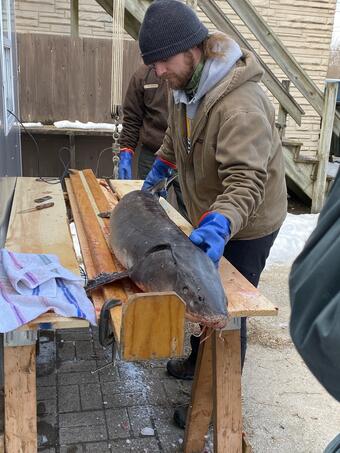
Jeremiah Shrovnal was a Master’s student at the Wisconsin Cooperative Fishery Research Unit (WICFRU) working with Dr. Daniel Isermann from 2019-2021. Working with Dr. Isermann, Jeremiah collaborated with the Wisconsin Department of Natural Resources (WDNR) to devise and employee an innovative approach to statistical models allowing WICFRU to include a “known fate” aspect to the models and account for tagged, harvested fish. This known-fate approach is innovative because in most fisheries, mandatory reporting of harvest is not required, and the fate of harvested fish is not known. Hence, the known fate approach improved the precision of mortality estimates. Jeremiah also did an excellent job interacting with WDNR partners who provided necessary data and engaged in scoping sessions along the way to help guide how Jeremiah formulated the models. Jeremiah has won CRU’s Best Student/Post-doc Paper for 2026 for his paper “Estimating mortality of Lake Sturgeon in the Lake Winnebago system using traditional age-based approaches and capture–recapture models” (citation below).
Paper Background and Citation:
The Lake Winnebago System in Wisconsin supports a popular winter spear fishery for Lake Sturgeon that is managed using harvest caps that are based on estimates of natural mortality rates that rely on ages estimated from fin rays, which are known to be inaccurate. The Wisconsin Cooperative Fishery Research Unit in collaboration with the Wisconsin Department of Natural Resources conducted research to determine if: 1) recent estimates of exploitation (u) have exceeded the 5% harvest cap, 2) total and natural mortality rates are similar among estimation methods that rely on corrected fin ray ages or capture-recapture methods, and 3) if potential differences in mortality rate estimates would affect safe harvest caps. Our results indicated that current management strategies have maintained harvest below target levels and that using capture-recapture models based on PIT tags to estimate natural mortality appears to provide the most conservative approach for setting harvest caps for the spear fishery. This information may be used to improve management efforts for this economically and socially important fishery.
Jeremiah S Shrovnal, Margaret H Stadig, Joshua K Raabe, Daniel A Isermann, Estimating mortality of Lake Sturgeon in the Lake Winnebago system using traditional age-based approaches and capture–recapture models, North American Journal of Fisheries Management, Volume 45, Issue 4, August 2025, Pages 616–632, https://doi.org/10.1093/najfmt/vqaf044
Awards Committee Comment:
The Awards Committee members were especially impressed with Jeremiah Shrovnal’s efforts to work with agency collaborators and staff harvest regulation stations even though it wasn’t required for the data collection efforts leading to this manuscript. Additionally, the manuscript involved complex statistical methods that resulted in practical management insights for the Wisconsin Department of Natural Resources.