



We monitor hydrologic conditions so you can make informed decisions
Our Scientists operate state-of-the-art data networks that provide spatially-consistent data to compare to historic trends
Our Scientists operate state-of-the-art data networks that provide spatially-consistent data to compare to historic trends
We investigate and study our world and its relation to water
NJWSC is highly involved in research into our ecosystems, streams, groundwater, and their health and water quality
NJWSC is highly involved in research into our ecosystems, streams, groundwater, and their health and water quality
USGS National Water Dashboard for New Jersey
USGS Mobile Flood Tool highlighting New Jersey
USGS Mobile Flood Tool highlighting New Jersey
Coastal Floodplain Inundation Map
New Jersey Groundwater Level and Trends
View current groundwater levels and long-term trends for continuous groundwater monitoring locations across New Jersey
View current groundwater levels and long-term trends for continuous groundwater monitoring locations across New Jersey
How does Ice on Rivers and Streams Affect USGS Streamflow Data
New Jersey Water Science Center
Welcome! Since 1903, the New Jersey Water Science Center has been collecting high-quality hydrologic data and conducting unbiased water-science research to address the water-resource priorities of the Nation, global trends and support statewide water-resource infrastructure and management needs.
New Jersey Current Water Conditions
New Jersey Current Water Conditions

Real-time New Jersey Streamflow, Groundwater, and Water-quality conditions available through the National Water Data Dashboard interactive map application.

NJ WSC Quick Links
NJ WSC Quick Links
Explore some of our more popular science and tools
News
Geospatial Applications to Visualize Science and Support Decision‑Making Across Scales
Geospatial Applications to Visualize Science and Support Decision‑Making Across Scales
Predictions of PFAS in groundwater at drinking water supply depths in the U.S.
Predictions of PFAS in groundwater at drinking water supply depths in the U.S.
USGS deploys “aftershock kits” to study Whitehouse Station earthquakes
USGS deploys “aftershock kits” to study Whitehouse Station earthquakes
Publications
Methods for estimating daily upstream location of the freshwater- saltwater interface along the Maurice and Cohansey Rivers, New Jersey Methods for estimating daily upstream location of the freshwater- saltwater interface along the Maurice and Cohansey Rivers, New Jersey
The Delaware River basin (DRB) provides drinking water to 15 million people in the surrounding area. Water is frequently withdrawn from the freshwater reaches of streams, above head of tide, in the DRB for use as public drinking water. During extended periods of low flow, saltwater can move upstream, which can threaten drinking-water supplies in the basin. Due to spatial patterns in...
Per- and polyfluoroalkyl substances (PFAS) and other contaminants of concern in tribal waters of Montana Per- and polyfluoroalkyl substances (PFAS) and other contaminants of concern in tribal waters of Montana
We assessed potential exposures to a broad suite of contaminants (inorganic, organic and microbial) in culturally important surface waters from three watersheds in a northern plains Native American community (Apsáalooke [Crow Tribe of Montana]) in south-central Montana, United States, with water insecurity concerns. Inorganic (37), organic (435) and microbial (3) constituents were...
Conducting feasibility assessments of potential conservation reintroductions: A case study with the imperiled foothill yellow-legged frog, Rana boylii Conducting feasibility assessments of potential conservation reintroductions: A case study with the imperiled foothill yellow-legged frog, Rana boylii
Conservation translocations are an increasingly common and often necessary component of recovering species that have become extirpated from portions of their range. Understanding and ameliorating potential threats that reduce the likelihood of successful population establishment at recipient sites is a key component of successful translocation planning. We examined multiple potential...
Science
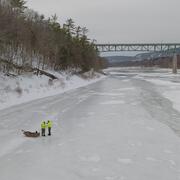
Delaware River at Montague Ice Affected Discharge Measurement
On February 11, 2026, a team of scientists from the New Jersey Water Science Center made a discharge measurement at the USGS 01438500 Delaware River at Montague, New Jersey monitoring site during ice cover conditions. This is the first time since February 1999 that this type of measurement was made at this site. Frigid winter weather conditions made the measurement both necessary and possible.

Saltwater Intrusion and Sea Level Rise Monitoring in New Jersey
Frequently, water withdrawals for public supply are made from the freshwater reaches of rivers and streams across new Jersey. Overall, there is a lack of scientific information describing the movement of saltwater upstream into the tributaries discharging into Delaware Bay. This project is beginning to collect water quality data along three selected tributaries in New Jersey to Delaware Bay in an...

Long-term Water Monitoring Networks in New Jersey
The accurate, long-term monitoring networks of New Jersey Water Science Center provide valuable data in real-time and historical perspective to compare that data to. The longer a monitoring location is in operation, the more valuable it becomes, since more statistical comparisons can be performed. Our field technicians continuously make field measurements and maintain these networks.